
Struggling with reef tank salinity? Learn how to use a refractometer, avoid common mistakes, and keep your reef aquarium perfectly balanced.
Posted by Charlie Downs on
The Complete Guide to Measuring Reef Aquarium Salinity with a Refractometer (2026)
Maintaining stable salinity in a reef aquarium is one of the most important factors in keeping corals, fish, and invertebrates healthy. Natural ocean water contains a very consistent salt concentration, and even small deviations in your aquarium can cause coral stress, reduced growth, or fish health issues.
For this reason, reef aquarists rely on precise tools to measure salinity. While several methods exist—including hydrometers and digital meters—most experienced hobbyists agree that a refractometer is the most reliable and practical tool for measuring reef tank salinity.
In this comprehensive guide, we will cover:
-
What reef aquarium salinity actually is
-
The difference between salinity and specific gravity
-
Why refractometers are more accurate than hydrometers
-
How refractometers work
-
How to properly calibrate a reef tank refractometer
-
Common mistakes reef hobbyists make
By the end, you’ll understand exactly how to measure salinity in a reef aquarium correctly.
What Is Reef Aquarium Salinity?
Salinity refers to the total concentration of dissolved salts in seawater. It is typically expressed as parts per thousand (ppt).
Natural ocean water averages about:
| Measurement | Value |
|---|---|
| Salinity | 35 ppt |
| Specific Gravity | ~1.026 |
| Temperature reference | 77°F / 25°C |
Most reef aquariums should maintain salinity between 34–36 ppt to replicate natural ocean conditions.
If salinity drifts outside this range, reef inhabitants can experience:
-
Coral tissue recession
-
Fish osmotic stress
-
Slower coral growth
-
Reduced coloration in SPS corals
Because reef ecosystems are extremely sensitive to salinity changes, accurate measurement is critical.
Salinity vs Specific Gravity (A Common Reef Hobbyist Confusion)
Many aquarium guides use the terms salinity and specific gravity interchangeably, but they are technically different measurements.
Salinity
Salinity measures the actual amount of dissolved salts in water.
It is expressed in:
-
ppt (parts per thousand)
-
‰
Example:
Natural seawater = 35 ppt
Specific Gravity
Specific gravity compares the density of seawater to pure freshwater.
Example:
-
Pure freshwater = 1.000
-
Reef tank seawater ≈ 1.026
However, density changes with temperature, which means specific gravity readings can vary if temperature corrections are not applied.
This is one reason why many reef aquarists prefer measuring salinity directly using a refractometer.
Common Tools Used to Measure Reef Tank Salinity
There are three main methods used in the saltwater aquarium hobby.
| Tool | Accuracy | Cost | Ease of Use |
|---|---|---|---|
| Swing-arm hydrometer | Low | $ | Easy |
| Glass hydrometer | Moderate | $$ | Moderate |
| Refractometer | High | $$ | Easy |
Let’s look at each method.
Swing Arm Hydrometers (Cheap but Often Inaccurate)
Swing-arm hydrometers are commonly included in beginner saltwater aquarium kits.
They work by measuring water density using a floating plastic arm.
Advantages
-
Cheap
-
Easy to read
-
Widely available
Disadvantages
-
Air bubbles cause inaccurate readings
-
Salt deposits affect measurements
-
Plastic arms lose calibration over time
Many reef aquarists discover their hydrometer readings are several ppt off, which can lead to serious salinity problems.
How Refractometers Measure Salinity
Unlike hydrometers, refractometers do not measure density. Instead, they measure how light bends (refracts) through saltwater.
The more dissolved salt in the water, the more light bends.


This optical principle allows refractometers to determine salinity very precisely using only a few drops of water.
When looking through the eyepiece, you’ll see a scale with a blue and white boundary line.
Where the line crosses the scale indicates:
-
Salinity (ppt)
-
Specific Gravity
Understanding the Refractometer Scale

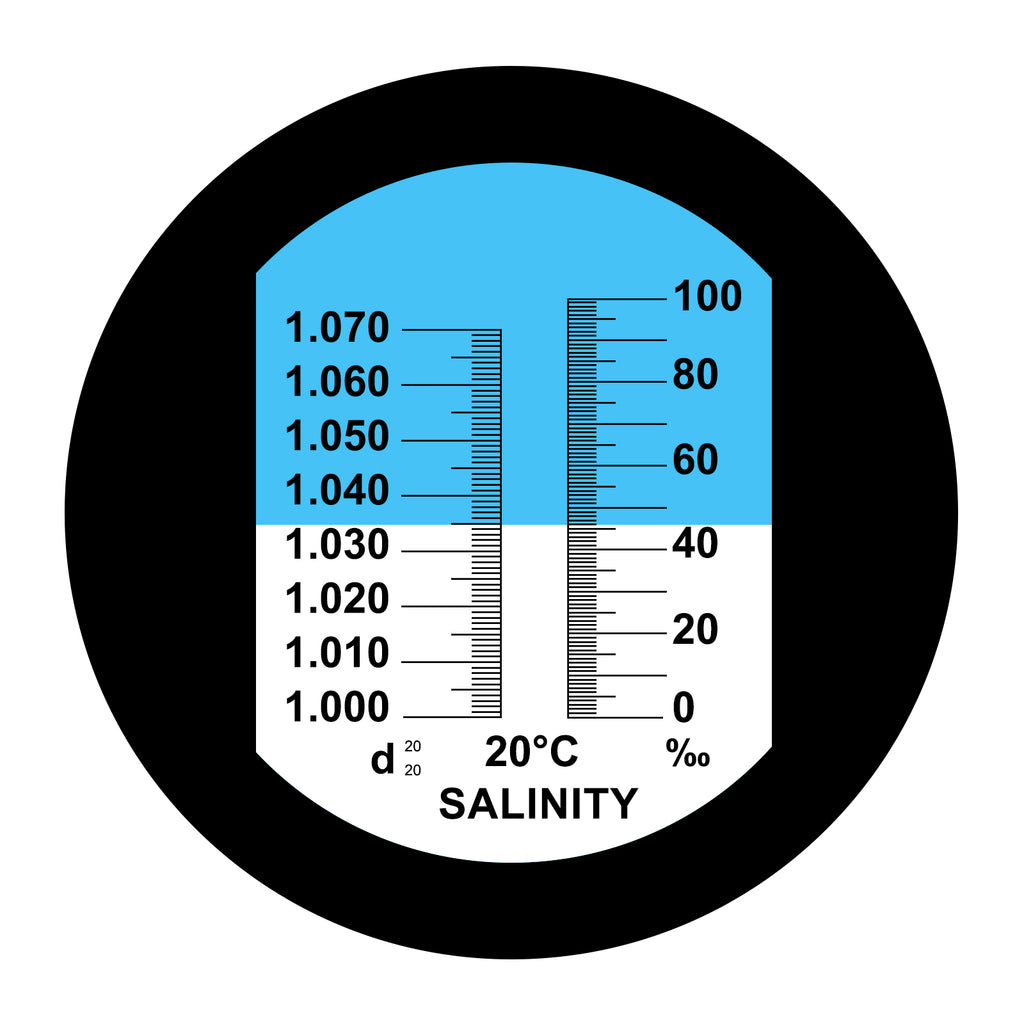

Most reef aquarium refractometers display two scales:
Left scale
Specific gravity (1.000 – 1.070)
Right scale
Salinity (0–100 ppt)
For reef tanks, the important value is:
35 ppt = ~1.026 specific gravity
Refractometers designed specifically for reef aquariums often feature a narrower scale from 20–40 ppt, making readings easier and more precise.
Why Refractometers Are More Accurate for Reef Aquariums
Refractometers are considered the best salinity measurement tool for reef tanks for several reasons.
1. Higher Precision
Refractometers can measure salinity within ±1 ppt, making them far more precise than swing-arm hydrometers.
Accurate salinity helps maintain:
-
stable coral growth
-
healthy fish osmoregulation
-
balanced reef chemistry
2. Minimal Temperature Impact
Many aquarium refractometers include Automatic Temperature Compensation (ATC).
ATC adjusts readings to compensate for temperature differences, ensuring reliable measurements between roughly 10°C and 30°C.
This is important because temperature changes can affect density-based measurements.
3. Faster and Easier Testing
Testing salinity with a refractometer requires only:
-
A few drops of aquarium water
-
Closing the prism plate
-
Looking through the eyepiece
The entire process takes less than 10 seconds.
4. More Reliable Long-Term Measurements
Because refractometers rely on optical physics instead of mechanical parts, they maintain accuracy much longer than plastic hydrometers.
Brine Refractometers vs Seawater Refractometers
One interesting detail many hobbyists don’t realize:
Many refractometers are designed to measure brine (pure sodium chloride) rather than natural seawater.
But seawater contains additional elements such as:
-
magnesium
-
calcium
-
potassium
-
sulfate
These slightly alter the refractive index of seawater.
Because of this difference, brine refractometers can read about 1.5 ppt lower than actual seawater salinity.
For the most accurate readings, use a refractometer designed specifically for seawater aquariums.
How to Calibrate a Reef Aquarium Refractometer
Even the best refractometer must be calibrated.
Many beginners calibrate incorrectly using RO/DI water, which can introduce small measurement errors.
The best method is calibrating with a 35 ppt calibration solution.
Calibration Steps
-
Place a drop of 35 ppt calibration solution on the prism.
-
Close the cover plate.
-
Look through the eyepiece.
-
Adjust the calibration screw until the scale reads 35 ppt (1.026 SG).
After calibration, rinse the prism with RO/DI water.
Calibrating monthly ensures consistent accuracy.
Ideal Reef Tank Salinity Range
Most reef aquariums thrive when salinity closely matches natural ocean conditions.
Recommended values:
| Parameter | Ideal Range |
|---|---|
| Salinity | 34–36 ppt |
| Specific Gravity | 1.025–1.026 |
| Temperature | 76–80°F |
More important than the exact number is consistency.
Sudden salinity swings can damage coral tissue and stress fish.
Common Mistakes When Measuring Salinity
Even experienced reef hobbyists sometimes make measurement mistakes.
1. Not Calibrating the Refractometer
Refractometers can drift over time.
Calibration should be performed every few weeks.
2. Using Freshwater Calibration
Freshwater calibration introduces small measurement errors.
Always use 35 ppt calibration fluid.
3. Salt Residue on the Prism
Salt crystals left on the refractometer prism can distort readings.
Always rinse with RO/DI water after use. Use 70% Isopropyl Alcohol on a cotton ball or as a wipe, and wipe off the prism and underside of the daylight plate.
4. Using a Brine Refractometer
Many inexpensive refractometers are designed for salt brine rather than seawater.
This can cause salinity readings to be 1–2 ppt inaccurate.
5. Too Small a Sample
1-2 drops is all you need, and the drops must cover the center of the prism.
Smooth out any air bubbles.
6. Daylight Plate is Aligned with the Prism to Hold Samples on the Prism
Be sure that the daylight plate is flush with the prism. Use the calibration screwdriver (or whatever method your refractometer requires) to rotate the daylight plate (in analog refractometers) to where samples will not run off the refractometer.
Best Practices for Measuring Reef Tank Salinity
To maintain accurate reef tank salinity:
✔ Test salinity weekly
✔ Use a calibrated refractometer
✔ Keep salinity near 35 ppt
✔ Avoid sudden salinity changes
✔ Top off evaporated water with freshwater only
These practices help maintain a stable reef ecosystem.
Final Thoughts: Why Every Reef Keeper Should Use a Refractometer
Maintaining proper salinity is one of the foundations of a successful reef aquarium.
While hydrometers may provide rough estimates, refractometers deliver the precision required to maintain stable marine conditions.
By using a properly calibrated seawater refractometer, reef hobbyists can confidently maintain the ideal salinity of 35 ppt, supporting:
-
healthy coral growth
-
stable reef chemistry
-
vibrant marine life
Whether you're starting your first saltwater aquarium or managing an advanced SPS reef tank, a refractometer remains one of the most important tools in reef keeping.
APPENDIX:
Reef Tank Salinity Calculator
Share this post
0 comment